

Every tournament has that one team that stays quiet in the background at first — no hype, no big predictions — and then suddenly, they’re the ones everyone can’t stop talking about.That’s the exact vibe when Varun Aaron mentioned a Group 1 team as the “dark horse” ahead of the Super 8 stage of the T20 World Cup 2026. It wasn’t a dramatic prediction or a bold headline — just a calm, knowing remark that makes fans pause and think, “Hold on… something might be quietly coming together here.
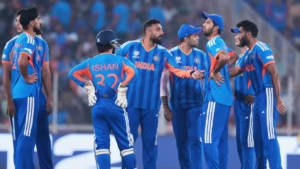
Usually, this kind of talk points to a team that’s getting the small things right. Bowlers sticking to smart plans. Batters staying composed when pressure rises. Fielders putting in that extra effort to save runs that don’t show up in highlight reels. Nothing dramatic — just disciplined, confident cricket. And in T20 games, that’s often all it takes to trouble the big names.
Cricket has a strange habit of backing the teams that go about their work quietly. The ones who build confidence little by little, without much noise, often end up being the hardest to beat when it really counts.. And honestly, the opponent that feels least threatening at first… is often the one that turns out to be the biggest challenge.
And if you’ve followed T20 cricket for a while, you already know why that label carries weight.
What “Dark Horse” Really Means in T20 Cricket
In everyday conversation, a dark horse is someone unexpected. In cricket, it’s more layered than that. A dark horse team isn’t weak. It’s underestimated.
They don’t dominate headlines. They don’t carry the burden of expectation. But they do carry a strong plan, defined roles, and a group that trusts the process.
That combination is powerful. When pressure builds — and it always does in a World Cup — teams playing with freedom tend to execute better. Shots are cleaner. Decisions are sharper. Panic arrives later, if at all.
From a fan’s perspective, you can almost see the difference. Some teams look like they’re protecting a reputation. Others look like they’re chasing a moment. The second type is dangerous.
Keyword Focus: T20 World Cup 2026 Prediction and Group 1 Dynamics
Any serious T20 World Cup 2026 prediction starts with understanding group dynamics. Group 1 appears balanced on paper — a mix of established contenders and evolving squads. That balance creates opportunity.
Dark horse teams typically share a few practical traits:
A settled opening pair that values intent over impulse
A flexible middle order that adapts to the match situation
At least two all-round options to balance risk
A bowling unit with variation, not just pace
Sharp fielding standards that save runs quietly
None of this is glamorous. But tournaments are rarely won by glamour alone. They’re won by consistency in small moments.
Why Fast Bowling Still Sets the Tone
Varun Aaron’s perspective carries weight because fast bowlers understand tempo. They feel pressure in overs, not just outcomes. And in T20 cricket, controlling tempo is half the battle.
A disciplined powerplay can suffocate an aggressive batting side. A clever middle-overs spell can break partnerships without taking wickets every ball. And a composed death over can flip a chase on its head.
Modern fast bowling is less about raw speed and more about control — angles, lengths, pace changes, and reading the batter’s intent. A unit that executes these details forces mistakes. And once mistakes arrive, momentum follows.
If a Group 1 team has quietly built a bowling attack that understands phases — powerplay, middle overs, death — calling them a dark horse isn’t dramatic. It’s logical.
Batting Without Panic: The New T20 Blueprint T20 batting used to be about constant attack. Now it’s about informed aggression. The best teams don’t swing at everything; they choose their moments.
Watch how composed sides approach an innings:
- They start with purpose, not recklessness
- They rotate strike when boundaries dry up
- They target match-ups instead of chasing highlight shots
- They accelerate late, when bowlers feel the squeeze
- This approach doesn’t always look explosive early. But it’s reliable. And reliability in pressure matches is gold.
A dark horse team that follows this structure can chase totals that look daunting and defend scores that look modest. Adaptability becomes their identity.
Leadership: Calm Is Contagious You can often spot a confident team by watching its captain between deliveries. No theatrics. No visible panic. Just quiet adjustments.
T20 captaincy is a test of clarity under time pressure. Field placements shift quickly. Bowling changes require instinct. And the game rarely allows second thoughts.
Dark horse teams often benefit from leaders who keep communication simple:
- Clear roles before the game starts
- Trust when things go wrong
- Quick decisions without overthinking
- Players respond to that environment. They take responsibility. They play the moment, not the noise around it.
- The Psychological Edge No One Talks About
Here’s a simple truth: favorites play with expectation; dark horses play with opportunity.
Expectation can be heavy. It turns every mistake into a headline. Opportunity feels lighter. It invites risk.
That psychological difference shapes how teams behave in tight finishes. One side tries not to lose. The other tries to win.
And in T20 cricket, the team trying to win often finds the decisive moment — a surprise slower ball, a brave fielding effort, a calculated hit over the infield when singles would be safer.
Confidence isn’t always loud. Sometimes it’s just the absence of fear.
Fielding: The Silent Multiplier
Ask any coach what separates good T20 teams from great ones and you’ll hear the same answer: fielding.
A saved boundary here. A direct hit there. A catch taken under pressure. These actions rarely trend on social media for long, but they reshape matches.
Dark horse teams often bring youthful energy and hunger. They chase every ball. They turn ones into twos. They create doubt in the batter’s mind.
Over a tournament, those small gains accumulate. Ten runs saved across phases can decide knockouts.
Reading the Super 8s: Where Preparation Meets Nerve
When the Super 8s start, the tournament feels more intense. Teams that looked comfortable earlier suddenly face tougher plans, tighter matches, and almost no margin for mistakes.. Preparation meets nerve.
This is where dark horse identities are tested — not by the spotlight, but by sustained pressure. Can they hold their method when momentum swings? Can they recover quickly after a setback?
If the answer is yes, they become more than a story. They become contenders.
Varun Aaron’s comment hints at a team that has built something quietly — structure, belief, and patience. Those qualities travel well in tournaments.
Practical Signs Fans Should Watch
If you enjoy analyzing matches beyond the scorecard, keep an eye on these indicators during the Super 8s:
Body language after a dropped catch — do they recover instantly?
Middle-overs intent — do they rotate strike when boundaries aren’t coming?
Bowling phase management — are key bowlers saved for key moments?
Field placements — proactive or reactive?
Bench usage — is the team flexible with combinations?
Teams that handle these details calmly usually punch above expectations.
Why This Prediction Resonates
Cricket history is filled with tournaments where momentum teams overshadowed reputations. Not because favorites lacked talent, but because someone else timed their peak perfectly.
Varun Aaron’s “dark horse” call resonates because it focuses on readiness rather than recognition. It suggests a side that understands its strengths and isn’t distracted by comparisons.
That’s a powerful place to operate from. When players trust the plan, execution becomes instinctive. And instinct often wins tight T20 games.
An Indian Fan’s Lens: Why We Love This Narrative
Indian fans have a deep connection with cricket stories, not just results. We celebrate journeys — the growth of a unit, the emergence of belief, the moment when preparation meets opportunity.
A dark horse run offers all of that. It invites hope without pressure. It makes every match feel open.
And it reminds us why we watch in the first place: to witness something unfold that numbers alone couldn’t predict.
Conclusion: Expect the Unexpected, Respect the Prepared
The beauty of T20 cricket lies in possibility. One phase can change everything. One decision can redefine a campaign